116719BLRO
GMT-Master II 'Pepsi' white gold
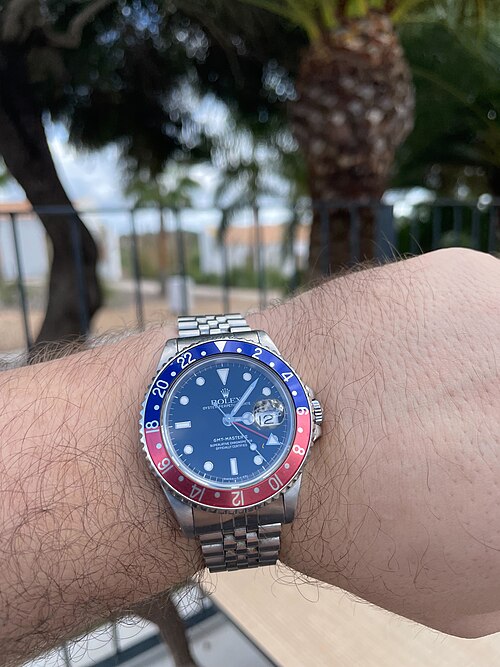
Red and blue Cerachrom bezel on an 18k white gold case. The Pepsi bezel was offered only in white gold before the steel 126710BLRO.
Not verified
To install WriStreet on your iPhone, tap then “Add to Home Screen”.
Install WriStreet on your phone: it opens like an app, even offline.
Verification: Verified by two sources
40 mm case · spring bars · 2018
20 mm is the most common lug width: 26% of watches share it.
Indicative information. Check your watch before buying a strap: wristreet.com is not responsible for an incorrect size.
Not sure this is your reference? It is engraved on the case back, or between the lugs at 6 o'clock.
Red and blue Cerachrom bezel on an 18k white gold case. The Pepsi bezel was offered only in white gold before the steel 126710BLRO.
Not verifiedAll 41 Rolex GMT-Master II references and their strap sizes
Own a Rolex GMT-Master II? Add your photo.Share a photo
The Rolex GMT-Master II "Pepsi" 126710BLRO (40 mm case) has a 20 mm lug width. Lug width is the gap between the lugs, and the strap must match it exactly.
Spring bars. System: Spring bar lugs 20 mm.
The story · Since 1955
On 3 October 1967 test pilot William J. Knight flew the X-15 to Mach 6.7 over the Mojave Desert, and the watch on his wrist was a GMT-Master.
Mach 6.7
speed reached by William J. Knight in the X-15 in 1967, GMT-Master on his wrist
The fourth hand of the GMT-Master tracked Greenwich Mean Time, then the international reference, on a 24-hour scale. Pan Am pilots appeared in Rolex advertisements wearing it.
Rolex equipped expeditions and record attempts with the GMT-Master: an overland crossing of 34 countries, a solo flight around the world, a hypersonic X-15 flight and the Apollo 13 mission.
The ref. 1675 arrived in 1959 and stayed in production until 1980, which makes it the reference most collectors picture. Anodised aluminium bezel inserts gave rise to nicknames: Pepsi for red and blue, Coke for red and black, Root Beer for brown and gold.
After the GMT-Master II arrived with an independently set hour hand, Rolex kept making the original GMT-Master alongside it for well over a decade. Production of the first model only stopped in 1999.
Strap size for these references: 20 mm
Rolex introduced a new movement in 1982, which let the hour hand be set on its own. The GMT-Master and the GMT-Master II coexisted until 2000.
Strap size for these references: 20 mm
In 2005 the GMT-Master II received the first ceramic bezel insert on a Rolex watch. In 2013 Rolex made its first single-piece, two-colour ceramic insert, in blue and black.
Strap size for these references: 20 mm
When Rolex moved the GMT-Master II bezel from aluminium to ceramic in 2007, red could not at first be produced satisfactorily in the material. In 2013 Rolex created the first two-tone ceramic bezel, in blue and black, for the steel model, and in 2014 it finally made a red and blue ceramic bezel, initially only in white gold.
Strap size for these references: 20 mm
In 2022 the GMT-Master II came with its winding crown on the left and a green and black bezel. In 2023 a grey and black insert appeared on a yellow Rolesor version and on an 18 ct yellow gold version.
Strap size for these references: 20 mm
In 2022 Rolex flipped the case: a green and black bezel, the crown on the left and the date at 9 o'clock, a layout no other Rolex shared at launch. In 2025 the white gold version received Rolex's first high-tech ceramic dial, in green.
Strap size for these references: 20 mm
In 2025 Rolex introduced its first ceramic dial, a green Cerachrom component on an 18 ct white gold model with the crown on the left. The dial is the same shade as the lower half of the bezel insert.
The first British woman to fly solo around the world wore a GMT-Master from Heathrow on 18 May to her return on 20 June, through 31 stopovers.
The US Air Force test pilot wore a GMT-Master when he flew the X-15 to Mach 6.7. Rolex says the record remains unsurpassed.
Guevara wore a GMT-Master; after his death the watch was taken from his wrist by CIA officer Felix Rodriguez.
Eastwood wore a GMT-Master in In the Line of Fire, and collectors nicknamed the brown and gold ref. 16753 the Clint Eastwood.
After winning the Geneva, Aachen and Spruce Meadows Grand Prix in succession, the show jumper received a GMT-Master II with a red and blue bezel. He is the only rider to have won the Rolex Grand Slam of Show Jumping.
As Pussy Galore in Goldfinger she wore a GMT-Master ref. 6542, and collectors later nicknamed the reference after her character.
The test pilot who first broke the sound barrier is best known for wearing a GMT-Master II ref. 16710, though not on the 1947 flight itself. Rolex later featured him in an advertisement.
Selleck wore the GMT-Master ref. 16750 in his famous TV show, which is why collectors call that reference the 'Magnum'.
Time+Tide names him among the astronauts who wore the blue and red bezel 'Pepsi' GMT-Master, on Apollo 13.
Time+Tide names him among the astronauts who wore the blue and red bezel 'Pepsi' GMT-Master on Apollo 14.
Mitchell wore a GMT-Master ref. 1675 on Apollo 14, visible in pre-launch and onboard footage, and later had the caseback engraved for his daughter before it came to auction in 2024.
The Apollo 17 command module pilot owned a circa 1968 GMT-Master ref. 1675 that he packed in his personal kit for the mission, later engraving the caseback as flown on Apollo XVII.
The former Batman actor was photographed in Los Angeles in 2022 wearing the black and blue GMT-Master II known as the Batman.
Holland wore a Batman GMT-Master II at the Spanish premiere of Uncharted in 2022.
Visiting the New Jersey set of his biopic Deliver Me From Nowhere, Springsteen was photographed wearing a Batman GMT-Master II.
British GQ says Mayer adopted the Batman early and was often seen wearing it on stage.
On the day of his last competitive match in 2022, Federer wore the then brand-new Sprite GMT-Master II; British GQ adds that he often favours the Batman.
Promoting Red One at Hamleys in London in November 2024, Johnson wore the Everose gold Root Beer GMT-Master II ref. 126715CHNR; his stylist says he found the watch himself.
GQ spotted Cruise in 2023 wearing the white gold Pepsi GMT-Master II, the version Rolex later paired with a blue dial.
The Spider-Man actor threw the first pitch at a Mets game at Citi Field wearing the Sprite ref. 126720VTNR on a Jubilee bracelet.
Costner wore a Pepsi GMT-Master II on the cover of GQ's Summer 2024 issue and through the whole shoot; the stylist chose it after trying a Cartier Tank and a vintage French watch, and it was not Costner's own.
The Pan Am captain used his GMT-Master to navigate the airline's first non-stop New York to Moscow flight in 1959.
Brando wore a GMT-Master in Apocalypse Now (1979) and removed its red-and-blue bezel himself.
During the 1969 Golden Globe Race the sailor navigated with only a sextant and his GMT-Master.
2022. The Sprite ref. 126720VTNR moved crown, crown guard and date to the left of the case; GQ notes it also keeps the crown off the back of the hand for wearers on the left wrist.
2022. A yellow gold ref. 116758SARU with a sapphire, ruby and diamond bezel sold for HKD 1,071,000 in February 2022, above its HKD 500,000 high estimate; a white gold 116759SA made CHF 138,600 at Sotheby's Geneva in November 2021.
2019. The ref. 1675 Marlon Brando wore in Apocalypse Now, his name scratched into the caseback, sold at Phillips Game Changers in New York in December 2019 for US$1.95 million to a telephone bidder. His daughter Petra Brando Fischer consigned it for her foundation for children in poverty.
2018. At Baselworld 2018 the Pepsi ceramic bezel came to steel in ref. 126710BLRO, delivered on a Jubilee bracelet with the new calibre 3285.
2014. Rolex released the red and blue Pepsi ceramic bezel in white gold in 2014; once a steel version arrived, white gold models moved to a navy blue dial and Rolex offered earlier owners a dial swap.
2013. Rolex produced the first two-colour ceramic bezel in blue and black for the steel GMT-Master II, quickly called Batman.
2013. The ref. 116710BLNR became the first GMT-Master II with a two-tone ceramic bezel; before Batman stuck, some called it the Bruiser or Blue Black.
2005. For the GMT-Master's 50th anniversary Rolex launched the yellow gold ref. 116718LN with a new Cerachrom bezel insert. A 2007 example sold at Phillips Geneva for CHF 50,400 against an estimate of CHF 15,000 to 25,000.
1997. To honour Chuck Yeager's 1947 supersonic flight, Japan's The Real McCoy's commissioned 50 GMT-Master ref. 16700 watches with his name in red on the dial.
1972. Ron Evans's GMT-Master travelled in his Personal Preference Kit aboard the Apollo 17 lunar module Challenger and spent about 75 hours on the Moon; it sold at Heritage Auctions in 2009 for $131,450 including buyer's premium.
1959. Rolex sponsored the Pegasus Overland Expedition and gave a GMT-Master to each of its eight British Army servicemen, who drove two off-road vehicles through 34 countries in 51 weeks.
1954. Pan American Airways approached Rolex for a watch its crews could use to track two time zones, leading to the first GMT-Master, ref. 6542.
Phillips Hong Kong sold number 01 of a 50-piece Chuck Yeager edition of the ref. 16710, made by the Japanese brand The Real McCoy's for the 50th anniversary of his 1947 flight, for HK$1,008,000 against an estimate of HK$160,000 to 240,000.
Steel version of the ceramic generation, black dial with green 24-hour hand.
Gold model with a redesigned case, heavier lugs and crown guards, black ceramic insert and calibre 3186.
Redesigned case with heavier lugs.
Calibre 3185 and a slimmer case; produced until 2007.
Case enlarged 2mm to 40mm, crown guards added and an aluminium insert fitted.
In 2005 the GMT-Master II became the first Rolex with a Cerachrom bezel insert, made of high-tech ceramic.
Rolex has made two-colour Cerachrom bezels since 2013. The first was the black and blue 'Batman' 116710BLNR.
The independently adjustable hour hand, introduced in 1982, lets the wearer change local time without disturbing the 24-hour reference hand.
The gap between the two lugs that hold the strap, in millimetres. A new strap must match it exactly: 20 mm lugs take a 20 mm strap.
Most watches use spring bars, so any strap of the right width fits. Many smartwatches use their own band system instead, such as Apple Watch bands or Garmin QuickFit.