1977year Seiko launched its first solar-powered watch, Calibre 4826, with 12 solar cells disguised as a chapter ring
2012year Seiko launched the GPS Solar Astron, the world's first GPS solar watch
10 months10 months: power reserve of the solar Calibre V157 used in several Prospex Solar divers, once fully charged
22consecutive years, 1996 to 2017, that Seiko Watch won Japan's Good Design Award, a run that includes the GPS Solar Astron
- 1977
Seiko's first watch powered by light
Seiko launched its first solar-powered watch in 1977, an analogue model using Calibre 4826 with twelve small solar cells disguised as a chapter ring around the dial, a year after Citizen's pioneering Crystron Solar Cell. The idea was simple: eliminate the battery change by recharging from light instead.
- 2012
The GPS Solar Astron
In 2012 Seiko launched the Astron, the world's first GPS solar watch, combining its solar charging technology with a GPS module that synchronises the time and time zone from satellite signals. The Seiko Museum credits it as a landmark in Seiko's drive to eliminate battery changes from quartz watches.
- 2014 to 2016
Prospex goes global, then goes solar
Seiko relaunched Prospex as an international collection around 2014. Two years later, in March 2016, Prospex welcomed its first GPS Solar watch other than the Astron itself: the Marinemaster GPS Solar Dual-Time, developed with ocean racer Kojiro Shiraishi, alongside a new family of World Time Solar Chronographs for sailors.
- 2018
Solar power for the 'tuna can' diver
Seiko fitted its solar Calibre V157 to the Prospex Street Series, a smaller, lighter take on the shrouded 'tuna can' diver case that traces back to the titanium Professional 600m of 1975. SJX described it as a 'Baby Tuna' in navy, olive or grey, water resistant to 200m and rated for roughly ten months on a full charge in total darkness.
- 2020
A solar 'Arnie' homage
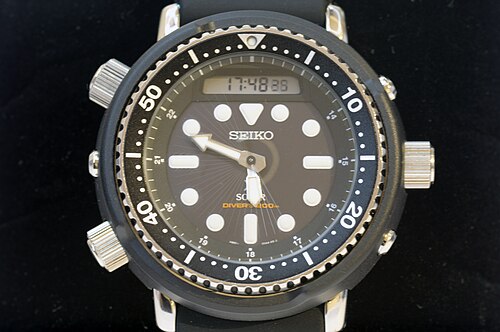
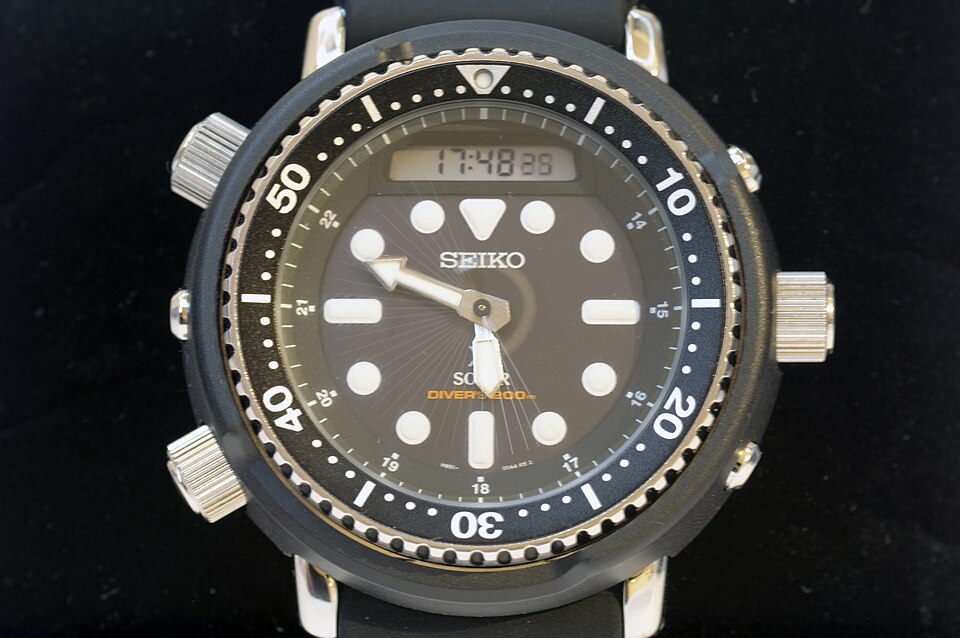
In 2020 Seiko's Street Series added an 'Urban Safari' colourway based on the analogue-digital 'Arnie', ref. H558-5009 of 1982, the watch SJX notes was worn on screen by Arnold Schwarzenegger in Predator and Running Man. The new version keeps the tuna-can shroud and ana-digi display but swaps the original's battery for the solar Calibre H851.
- 2022
A solar Speedtimer chronograph
Seiko marked its 1969 Speedtimer chronograph with three new solar chronographs, powered by the solar Calibre V192, which adds a 24-hour subdial and a six-month power reserve to the original design's tachymeter and chronograph functions.
- 2026
A 145th-anniversary solar chronograph
For Seiko's 145th anniversary, the Prospex Speedtimer solar chronograph line added a limited edition of 8,000 pieces, ref. HBJ005, with a dial coloured 'Edo purple' after a hue associated with the Edo-period aesthetic of old Tokyo.
✦2020. The non-solar 1982 Seiko H558-5009, nicknamed 'Arnie' after Arnold Schwarzenegger wore it on screen in Predator and Running Man, became the design template for a 2020 Prospex Street Series 'Urban Safari' watch that keeps the look but is powered by the solar Calibre H851 instead of a battery. SJX, an approved horology press source, is explicit that it is Schwarzenegger's film role, not personal ownership of the new solar version, that gives the homage its name.
✦2016. Seiko and sailor Kojiro Shiraishi co-developed the Prospex Marinemaster GPS Solar Dual-Time for his entry in the 2016-17 Vendee Globe, the first by any Asian sailor. Shiraishi requested a UTC-only bezel, extra-legible hands and smooth case edges to avoid catching a line, and wore it on his boat Spirit of Yukoh until dismasting forced him to retire off South Africa in December 2016.