CBS2212.FC6535
Carrera Chronograph Glass Box blue
Blue-dial Carrera Chronograph Glass Box in stainless steel.
21 mm
To install WriStreet on your iPhone, tap then “Add to Home Screen”.
Install WriStreet on your phone: it opens like an app, even offline.
Verification: Verified by the maker
39 mm case
Attachment: to verify
Other case sizes: 42 mm case, 22 mm
Indicative information. Check your watch before buying a strap: wristreet.com is not responsible for an incorrect size.
Not sure this is your reference? It is engraved on the case back, or between the lugs at 6 o'clock.
Blue-dial Carrera Chronograph Glass Box in stainless steel.
21 mmBlue dial on a steel bracelet.
20 mmPanda dial on a steel bracelet.
Not verifiedSkipper version of the Carrera Glass Box with a blue dial.
Not verifiedCarrera Chronosprint Glass Box 42, a 2023 Porsche edition.
Not verified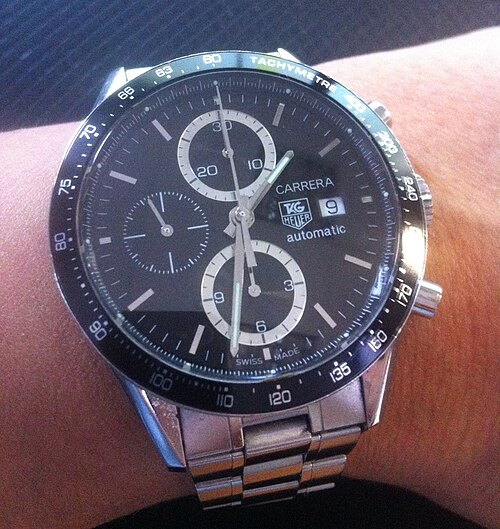
Own a TAG Heuer Carrera? Add your photo. Share a photo
The TAG Heuer Carrera Chronograph 39 mm CBS2210.FC6534 has a 20.7 mm lug width, as printed by TAG Heuer. That is not a standard strap size, so a 20 mm strap is not confirmed to fit.
The story · Since 1962
In 1971 Jack Heuer began handing solid gold Carrera chronographs to Ferrari's Formula 1 drivers, and Niki Lauda, Clay Regazzoni and Mario Andretti wore them at the track through the 1970s. Collectors still call that reference the "Ferrari Carrera".
3,000 km
length of the Mexican road race that gave the Carrera its name
Worn by
Niki Lauda, Clay Regazzoni, Mario Andretti, Jacky Ickx, Ronnie Peterson
At Sebring in 1962 Jack Heuer met the parents of the Rodriguez brothers, who told him about the Carrera Panamericana. He registered the name and launched the first Carrera, reference 2447, at the Basel Fair in 1963.
The first Carrera, Ref. 2447, was a 36 mm hand-wound chronograph offered with silver or black dials. Buyers could choose a tachymeter, decimal-minute or pulsometer scale, and racers mostly took the tachymeter. Calendar versions, gold cases, panda and reverse-panda dials and two- or three-register layouts followed.
In March 1969 the Carrera received the Calibre 11, developed in secret with Breitling, Hamilton-Buren and Dubois Dépraz, and it was the first automatic chronograph movement on the global market. Through the 1970s the gold 1158 CHN became the drivers' watch, and every Ferrari Formula One driver from 1971 to 1979 was offered one.
In 1971 Heuer sponsored Scuderia Ferrari, which Time+Tide describes as a first for a watchmaker. Jack Heuer gave the team's drivers the 18k gold Ref. 1158CHN, and Sotheby's notes that fewer than 500 examples of reference 1158 are known to have been produced in 18k yellow gold.
Squeezed by the quartz crisis, Jack Heuer sold the company in 1982 to investors including Piaget and Lemania. The Carrera was dropped in 1984, and in 1985 Techniques d'Avant Garde bought the firm, which became TAG Heuer.
Financial trouble forced Jack Heuer to sell the company in January 1982, and the new owners brought the Lemania 5100 calibre to the Carrera line. By 1985, when TAG bought Heuer, the Carrera had disappeared from the catalogue altogether. The line stayed out of production until the mid-1990s.
TAG Heuer relaunched the Carrera in 1996 with three re-editions in a 36 mm stainless steel or gold case that followed the 1963 design almost exactly. Jack Heuer later said the brand was the first to reproduce a historical model and make it saleable, and the re-edition inspired a new generation of vintage Heuer collectors.
The name returned in 1996 with a 36 mm re-edition series introduced by Jack Heuer himself, the first Carrera added to the catalogue since 1985. Sponsorships of Red Bull Racing and a Porsche edition later kept the watch tied to the track.
In 2002 TAG Heuer scaled the Carrera up to 39 mm. In 2004 the CV20XX series, at 41 mm on the Calibre 16 movement, added a fixed external tachymeter bezel, a first for the line. The Carrera Calibre 360, unveiled in 2005, measured 1/100th of a second.
In 2010 the Carrera got its first movement made by TAG Heuer itself, the Calibre 1887, a column-wheel chronograph. The new Carrera went back to the 1963 layout, with twelve applied hour markers and polished matchstick hands.
In 2015 TAG Heuer introduced the Heuer 02, a column-wheel automatic chronograph made in its own movement workshop. For the 60th anniversary in 2023 it released a limited edition recalling the panda-dial 2447, and the movement evolved into the TH20-00 with 80 hours of reserve.
Strap size for these references: 22 mm
In 2023 TAG Heuer marked the Carrera's 60th anniversary with a limited edition that referenced the Panda dial 2447. The 2015 Heuer 02 movement had by then evolved into the in-house TH20-00, which carries 80 hours of power reserve.
Strap size for these references: 22 mm
The Austrian drove for Ferrari in Heuer's sponsorship years and wore the solid gold Ref. 1158CHN with a black-on-gold panda dial.
Phillips lists the Swiss Ferrari driver among the Grand Prix racers who wore the gold "Ferrari Carrera" at the track in the 1970s.
One of the Ferrari drivers who received a solid gold Carrera from Jack Heuer when the sponsorship began.
Jack Heuer presented the Swedish driver with a gold Ref. 1158 around 1972 when he signed with Heuer, after his drive at the German Grand Prix at the Nurburgring.
Heuer's first paid endorsee in 1969; Phillips says he was also among the ambassadors given the gold Ferrari Carrera.
Jack Heuer gave the nine-time motorcycle world champion, then driving for Team Surtees, a gold Carrera 1158 engraved for his 1973 season, likely for pulling Regazzoni from his burning car at the South African Grand Prix.
Jack Heuer engraved a gold Carrera 1158 CHN for the Italian for an excellent collaboration, and Bonhams says he wore it while a Ferrari works driver in Formula 1 and sports prototypes. It sold at Goodwood Revival in 2015 for £21,875.
The star of Grand Prix owned and wore a unique Carrera 3647N with his own name printed on the dial; Phillips links it to his life as a racing enthusiast and Indianapolis 500 pace car driver. This is personal ownership, not a film prop.
Film role: as Carroll Shelby in Ford v Ferrari he wears a Heuer Carrera ref. 7753 with white dial and black sub-dials, an early-1970s watch in a story set in 1966.
Film role: as boy-band singer Hayes Campbell in The Idea of You he leaves his 39 mm steel Carrera at Solene's house as a reason to return. He wore the same Carrera Date to the film's New York premiere on 29 April 2024.
Film role: as gallery owner Solene in The Idea of You she wears the Carrera when the romance is going well; the watch changes wrists with the state of the couple.
2024. Bonhams London, 19 June 2024: a gold 1158 CH given in 1973 to Team Surtees sponsorship manager Terence Regan, one of six Jack Heuer ordered for the team of John Surtees, Alan Jones and Mike Hailwood, sold for £40,960.
2024. Film, The Fall Guy (2024): Ryan Gosling's stuntman Colt Seavers wears the Carrera Chronograph Glassbox ref. CBS2210.FC6534 in reverse panda throughout the film. In The Idea of You the same year, a 39 mm Carrera becomes a plot device between Nicholas Galitzine and Anne Hathaway, and TAG Heuer says that one was not a paid placement.
2022. Phillips, The New York Watch Auction: SIX, June 2022: James Garner's unique Carrera 3647N with his name on the dial made $176,400 on a $20,000 to 40,000 estimate, part of it for the James Garner Animal Rescue Fund. Robb Report says the TAG Heuer Museum bought it.
2022. Film, The Gray Man (2022): Ryan Gosling's CIA assassin Sierra Six wears a three-hand Carrera with silver dial, chosen in pre-production by Netflix, the Russo brothers and TAG Heuer.
2019. Another gold 1158CHN sold at Phillips Geneva for CHF 30,000, again above its estimate.
2019. Film, Ford v Ferrari (2019): Matt Damon plays Carroll Shelby wearing a Heuer Carrera ref. 7753, while Christian Bale as Ken Miles wears an Autavia.
2017. At Phillips Geneva, in a sale devoted to Heuer chronographs of the Jack Heuer era, a circa 1971 "Ferrari Carrera" Ref. 1158CHN made CHF 35,000 against a top estimate of CHF 25,000.
2016. Sotheby's in Geneva offered Ronnie Peterson's gold Carrera together with a 100 g fine gold bar, the "Prix Rouge et Blanc Joseph Siffert" given for outstanding bravery.
1971. Heuer sponsored the Scuderia Ferrari Formula 1 team, the first time a watchmaker sponsored an F1 team according to Time+Tide, and Jack Heuer invited the drivers to collect gold chronographs at the factory.
Jack Heuer conceived the Carrera in 1963 as a highly legible chronograph in a case inspired by modernist architecture, naming it after the Carrera Panamericana.
The Carrera Calibre 1887 Chronographe won the GPHG Petite Aiguille Prize in 2010.
The Carrera Calibre 360 won the GPHG Sports Watch Prize in 2006.
For the 60th anniversary, a 39 mm Carrera arrived with a domed glassbox crystal and the TH20-00 calibre, an updated Heuer 02 with 80-hour power reserve.
Supplied on calfskin straps (perforated racing strap on CBS2210.FC6534) with a steel folding clasp.
TAG Heuer made the Carrera Heuer 01 its new flagship chronograph: a 45 mm modular case of twelve parts around a calibre based on the in-house 1887.
The Carrera returned as a retro watch inspired by reference 2447, with hand-wound Lemania or automatic ETA chronograph movements.
The Carrera Automatic 510.511 used a 40 mm case and the Lemania 5100. The Carrera was discontinued in 1984 after the quartz crisis.
The 1970s Carrera moved to a barrel-shaped case enlarged by 2 mm, losing its long horns, with the automatic Calibre 12.
Heuer and its partners launched the Calibre 11, described as one of the first automatic chronographs, and it went into the Carrera.
Jack Heuer launched the Carrera chronograph, named after the Carrera Panamericana race. The first reference 2447 had a 36 mm round case and a hand-wound Valjoux 72.
Fratello calls the Carrera the first watch made solely for auto racing.
For legibility, Jack Heuer moved the seconds scale onto the tension ring and the fifth-of-a-second scale onto its inner bevel.
The gap between the two lugs that hold the strap, in millimetres. A new strap must match it exactly: 20 mm lugs take a 20 mm strap.
Most watches use spring bars, so any strap of the right width fits. Many smartwatches use their own band system instead, such as Apple Watch bands or Garmin QuickFit.